Top Health Tracking Gadgets Without Screens
Discover the best health tracking gadgets that work without a screen from smart rings to chest straps and learn how they deliver better data with zero distractions.
Abu Bakar
Top Health Tracking Gadgets Without Screens
You don't need a glowing wrist display to understand your body. The quietest wearables might actually tell you the most.
Here's a question worth sitting with: if your smartwatch died tomorrow, would you actually miss the screen or just the data it was quietly gathering?
For most of us, it's the data. The heart rate trends, the sleep cycles, the recovery scores. And yet, the health tech industry spent years convincing us that all of this required a bright rectangle strapped to our wrist, buzzing with notifications and draining by noon.
It doesn't. A new generation of screenless health trackers has arrived lean, elegant, and obsessively focused on the signal rather than the interface. No distractions. No glances. Just your body, tracked with precision, surfaced later when you actually want to read it.
If you've been quietly skeptical of the smartwatch lifestyle, or if you simply want a device that disappears into your day rather than demanding your attention, this guide is for you.
Why screenless? The case is stronger than you think
Before diving into the gadgets themselves, it's worth understanding why screenless trackers have moved from niche curiosity to mainstream consideration so quickly.
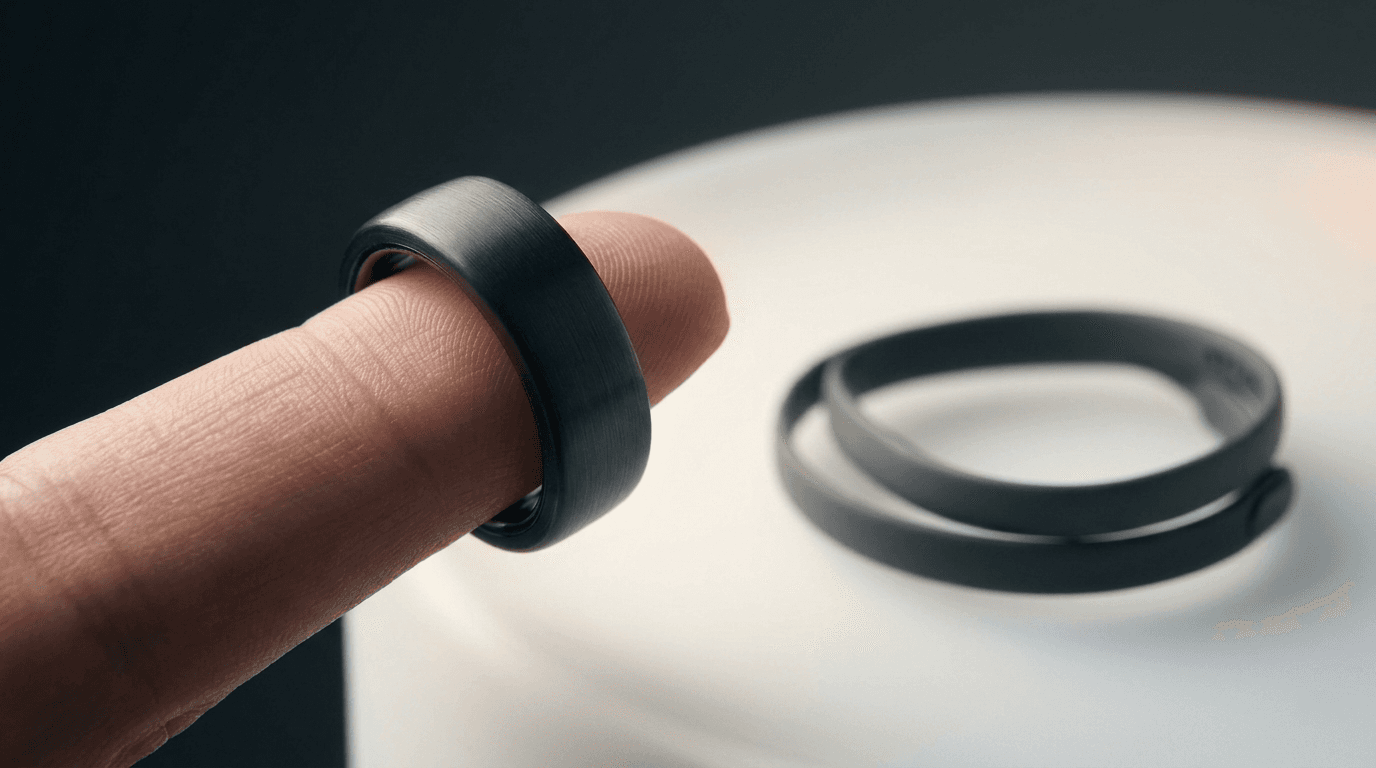
The obvious answer is battery life. Without a display to power, these devices last days sometimes weeks on a single charge. The Oura Ring, for instance, routinely delivers five to seven days between charges. That's not a minor improvement over a smartwatch; it's a fundamentally different relationship with your device.
But the deeper benefit is psychological. Screens invite interaction. They surface messages, news, and alerts at the exact moments you should be present a workout, a conversation, a walk. Screenless trackers collect without interrupting. You get the intelligence without the noise.
And then there's sensor placement. Fingers, chest, and upper arm often yield cleaner biometric data than the wrist, where movement artifacts and loose fit frequently compromise accuracy. Removing the screen makes room for better hardware in better locations.
The leading gadgets worth your attention
Oura Ring (Gen 3 & Gen 4)
The ring that redefined the category. Worn on the finger where blood flow is strong and consistent the Oura tracks heart rate, heart rate variability, body temperature, blood oxygen, and sleep architecture with genuinely impressive accuracy. Its Readiness Score has become something of a cult metric among athletes and executives alike, distilling overnight recovery into a single daily number. The companion app is one of the most thoughtfully designed in wearables. If you're only going to try one screenless tracker, this is the starting point.
Whoop 4.0
Whoop doesn't sell hardware it sells a membership, and the strap comes free with it. That model tells you something about where the value lies: entirely in the data analysis. Worn on the wrist or upper arm, Whoop is built for performance athletes who want to know not just how hard they trained, but how well they recovered. Its strain and recovery algorithms are notably sophisticated, and it captures 24/7 heart rate with a level of consistency that rivals clinical monitors. The screenless design means zero distractions during workouts exactly what serious training demands.
Polar H10 Chest Strap
If accuracy is your non-negotiable, no wrist-worn device beats a chest strap and the Polar H10 is the gold standard. Cardiologists use ECG-grade references from chest-level sensors; the H10 delivers precisely that, connecting via Bluetooth or ANT+ to your phone, gym equipment, or dedicated Polar watch. It's not glamorous, and it's not designed for all-day wear. But for structured workouts where clean heart rate data matters cycling, running, HIIT nothing touches it. A staple in the kit bags of coaches and serious amateurs for years.
Amazon Halo Rise
A different format entirely the Halo Rise sits on your nightstand rather than your body. It uses radar-based sensing to track your breathing patterns and movement through the night without any contact whatsoever. No chest strap, no ring, no wristband. The result is a sleep tracker that requires literally zero effort to wear. The sunrise alarm feature, which gradually brightens to wake you during a light sleep phase, has earned devoted fans among those who find traditional alarms brutal. It's not the deepest biometric platform, but for effortless sleep improvement, it's hard to beat.
Ultrahuman Ring AIR
Oura's most capable competitor in the ring category. The Ultrahuman Ring AIR is lighter than its rivals genuinely feather-light and its metabolic health features distinguish it from the pack. The app's focus on glucose management, circadian alignment, and functional wellness makes it particularly compelling for anyone approaching health from a longevity or optimization angle. Its sleep tracking granularity rivals Oura, and the hardware design is notably refined. A strong choice if you want ring-form-factor tracking without an Oura subscription.
Muse S Headband
Everything so far has focused on the body. The Muse S tracks the mind. A soft, fabric headband worn during meditation or sleep, it reads EEG brainwave signals and translates them into real-time audio biofeedback during sessions guiding you toward calm through gentle soundscapes. For sleep, it offers advanced EEG-based sleep staging that even dedicated ring trackers can't replicate. It occupies a niche, but it's a genuinely important one. If stress, focus, or sleep quality is your primary concern, no other consumer device goes this deep.
How to choose the right one for you
The most important question isn't "which tracker is best?" It's "what are you actually trying to understand about your health?" These devices track different things with different tools, and picking based on spec sheets alone often leads to buyer's remorse.
If you train hard and recovery is your primary concern, Whoop's subscription model and athlete-focused algorithms are hard to argue with. If you want a single device for everything sleep, HRV, activity, temperature the Oura Ring offers the most balanced package in the most unobtrusive form. If raw workout heart rate accuracy matters above all else, Polar's chest strap wins outright.
For people who find even a ring intrusive at night, the Amazon Halo Rise offers genuine sleep intelligence with zero wearable friction. And for those whose interest runs deeper into brainwave patterns, metabolic health, or serious longevity monitoring the Muse S and Ultrahuman Ring each carve out compelling territory that mainstream wearables simply don't address.
The bigger picture: data without distraction
There's a quiet irony in the health wearables market. The devices most loudly competing for your attention vibrating, buzzing, displaying notifications on your wrist are often the ones least useful for actual health. Their screens are primarily notification systems dressed up as health tools.
The screenless trackers in this list have made a different bet: that your health data is most valuable when you review it intentionally, in your own time, with context and reflection not when it's interrupting your run or your meeting or your sleep.
That bet is paying off. The category is growing fast, the technology is maturing rapidly, and the users who make the switch tend to stay switched. Once you've worn a tracker that disappears completely into your life, it's hard to go back to one demanding your attention every twenty minutes.
Tags
Comments (1)
Excellent overview of screenless health trackers. The article clearly explains their benefits, compares top options effectively, and highlights how meaningful health insights can be gained without the distractions of traditional smartwatches.